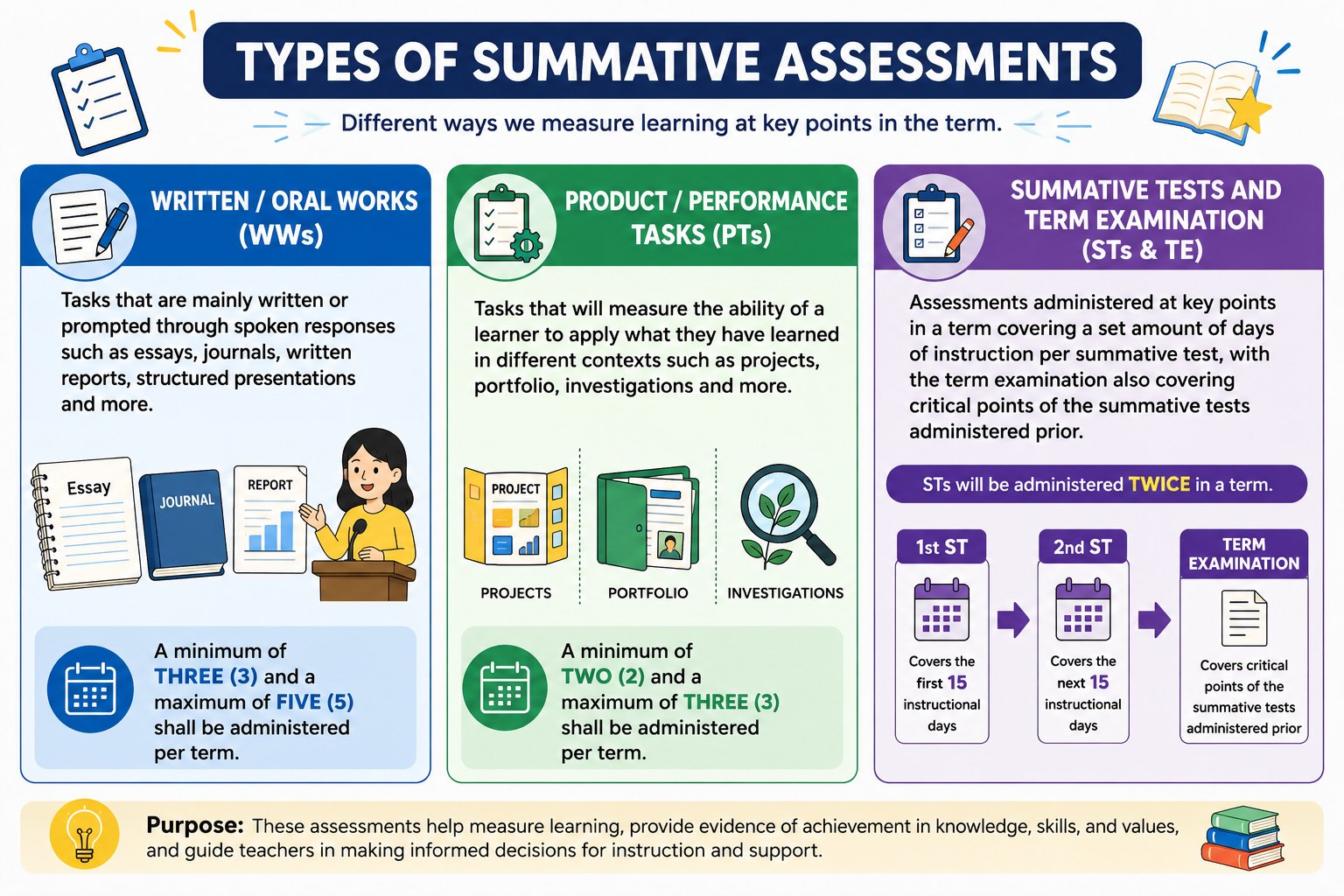
Summative assessments are different methods used to evaluate student learning at specific points during a term. These assessments measure how well learners have understood the lessons and achieved the learning objectives.
There are three main types of summative assessments:
Written and Oral Works (WWs)
These include tasks that are written or delivered through spoken responses. Examples are essays, journals, written reports, and structured presentations. Typically, a minimum of three (3) and a maximum of five (5) tasks are given per term.
Product or Performance Tasks (PTs)
These tasks measure how well students can apply what they have learned in real-life or practical situations. Examples include projects, portfolios, and investigations. Usually, a minimum of two (2) and a maximum of three (3) tasks are required per term.
Summative Tests and Term Examination (STs & TE)
These are formal assessments given at key points during the term. Summative tests are conducted twice and cover specific instructional periods, while the term examination evaluates important concepts based on the previous tests.
Purpose:
Summative assessments help measure learning progress, provide evidence of students’ knowledge, skills, and values, and guide teachers in making informed decisions to support student development.