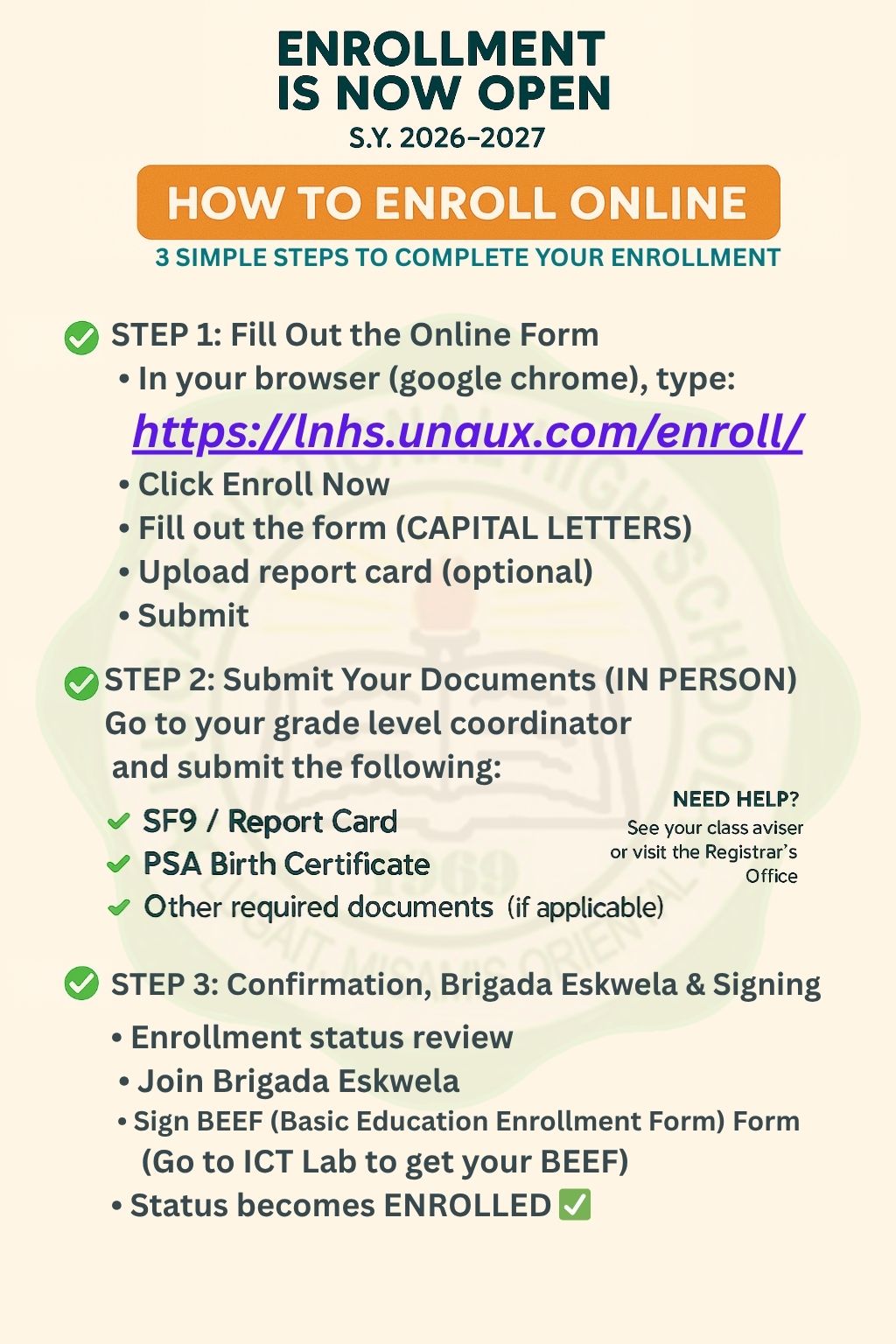
Online enrollment for the upcoming school year is now open (just click https://lnhs.unaux.com/enroll/). Required documents include: Report Card, Birth Certificate, and 2x2 ID photos.
Overview
This orientation aims to help parents and guardians better understand DepEd Order No. 009, s. 2026, which provides updated policies and guidelines affecting learners, school operations, and home–school collaboration. The order emphasizes shared responsibility between the school and families in supporting learners’ academic progress, well-being, and overall development.
Objectives of the Orientation- To explain the key provisions of DepEd Order No. 009, s. 2026
- To clarify the roles of parents, learners, and the school
- To ensure parents are informed about expectations, policies, and procedures
- To strengthen partnership and communication between home and school
Parents play a vital role in implementing DepEd policies. Through proper understanding and cooperation, we can create a safe, supportive, and learner-centered environment that promotes quality education for all.

Overview
This orientation aims to help parents and guardians better understand DepEd Order No. 009, s. 2026, which provides updated policies and guidelines affecting learners, school operations, and home–school collaboration. The order emphasizes shared responsibility between the school and families in supporting learners’ academic progress, well-being, and overall development.
Objectives of the Orientation- To explain the key provisions of DepEd Order No. 009, s. 2026
- To clarify the roles of parents, learners, and the school
- To ensure parents are informed about expectations, policies, and procedures
- To strengthen partnership and communication between home and school
Parents play a vital role in implementing DepEd policies. Through proper understanding and cooperation, we can create a safe, supportive, and learner-centered environment that promotes quality education for all.

Overview
This orientation aims to help parents and guardians better understand DepEd Order No. 009, s. 2026, which provides updated policies and guidelines affecting learners, school operations, and home–school collaboration. The order emphasizes shared responsibility between the school and families in supporting learners’ academic progress, well-being, and overall development.
Objectives of the Orientation- To explain the key provisions of DepEd Order No. 009, s. 2026
- To clarify the roles of parents, learners, and the school
- To ensure parents are informed about expectations, policies, and procedures
- To strengthen partnership and communication between home and school
Parents play a vital role in implementing DepEd policies. Through proper understanding and cooperation, we can create a safe, supportive, and learner-centered environment that promotes quality education for all.

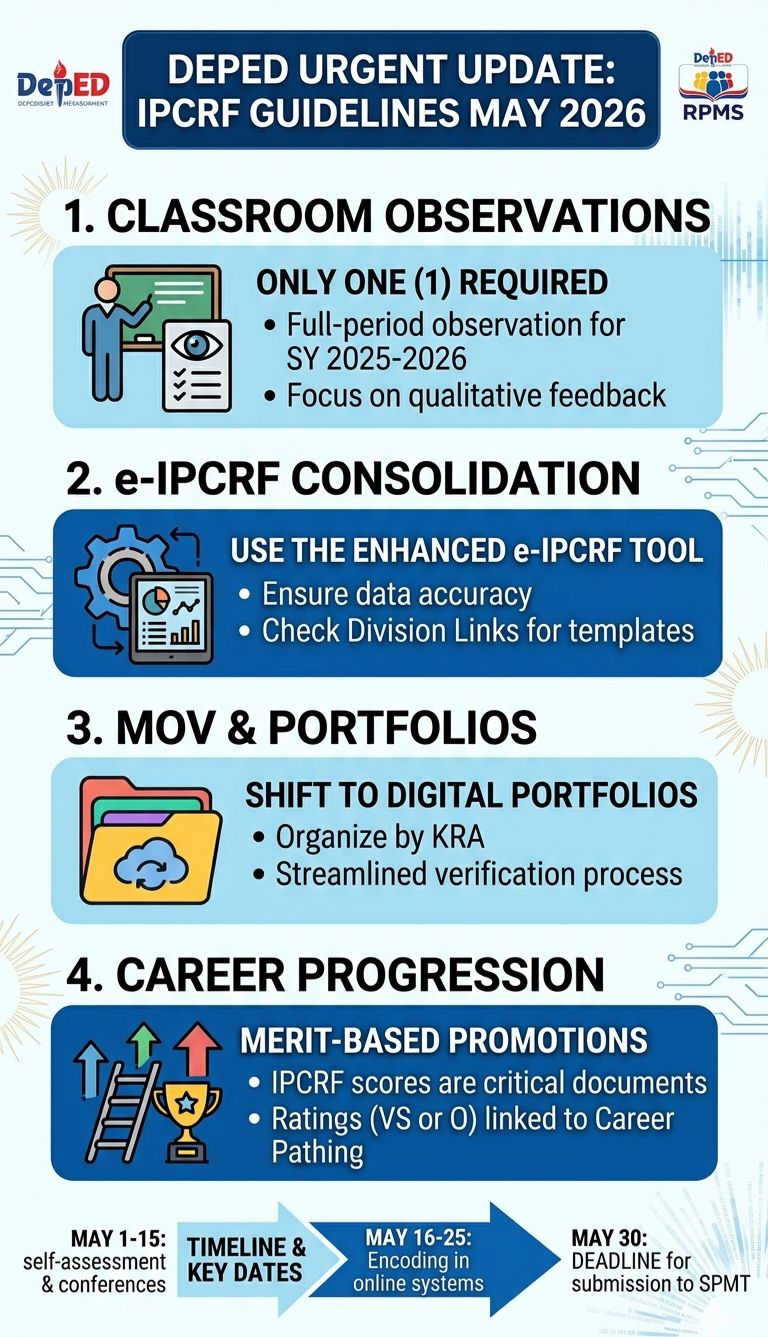
The Department of Education releases important updates on the implementation of the Individual Performance Commitment and Review Form (IPCRF) for School Year 2025–2026. These guidelines aim to streamline performance assessment, ensure data accuracy, and strengthen career progression for teaching personnel.
Key Highlights1. Classroom Observations
Only one (1) full-period classroom observation is required for the entire School Year 2025–2026. The emphasis is on qualitative feedback to support professional growth rather than compliance.
2. e-IPCRF Consolidation
All schools are advised to use the enhanced e-IPCRF tool to ensure accurate encoding and reporting. Official templates will be provided through Division-issued links to maintain standardization.
3. MOV and Portfolios
There is a shift from hard copies to digital portfolios. Teachers are encouraged to organize their Means of Verification (MOVs) according to Key Result Areas (KRAs) to allow faster and more efficient verification.
4. Career Progression
IPCRF ratings play a vital role in merit-based promotions. Performance ratings such as Very Satisfactory (VS) and Outstanding (O) are recognized as critical documents in career pathing and advancement.
- May 1–15: Self-assessment and performance conferences
- May 16–25: Encoding of IPCRF ratings in online systems
- May 30: Deadline for submission to the SPMT
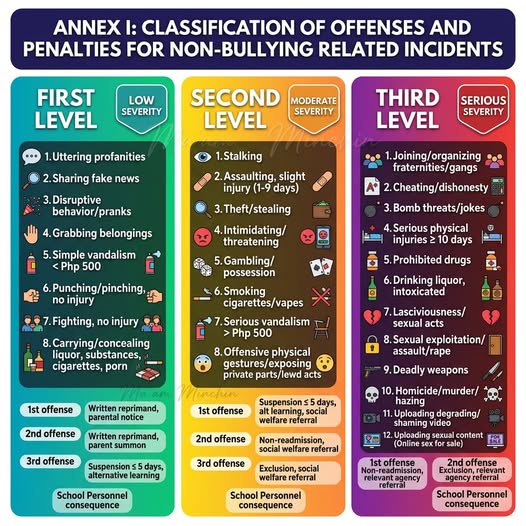
This annex outlines a clear, graduated system for addressing non‑bullying related student offenses based on severity—First Level (Low), Second Level (Moderate), and Third Level (Serious). It specifies corresponding behaviors, sanctions, and school personnel actions to ensure fair, consistent, and restorative discipline while promoting student accountability, safety, and well‑being within the school community.
AI in education serves as an auxiliary tool that enhances teaching, learning, and assessment. It supports instructional design, feedback, and efficiency—while human judgment, teacher supervision, and ethical use remain central to ensuring meaningful, fair, and learner‑centered education.

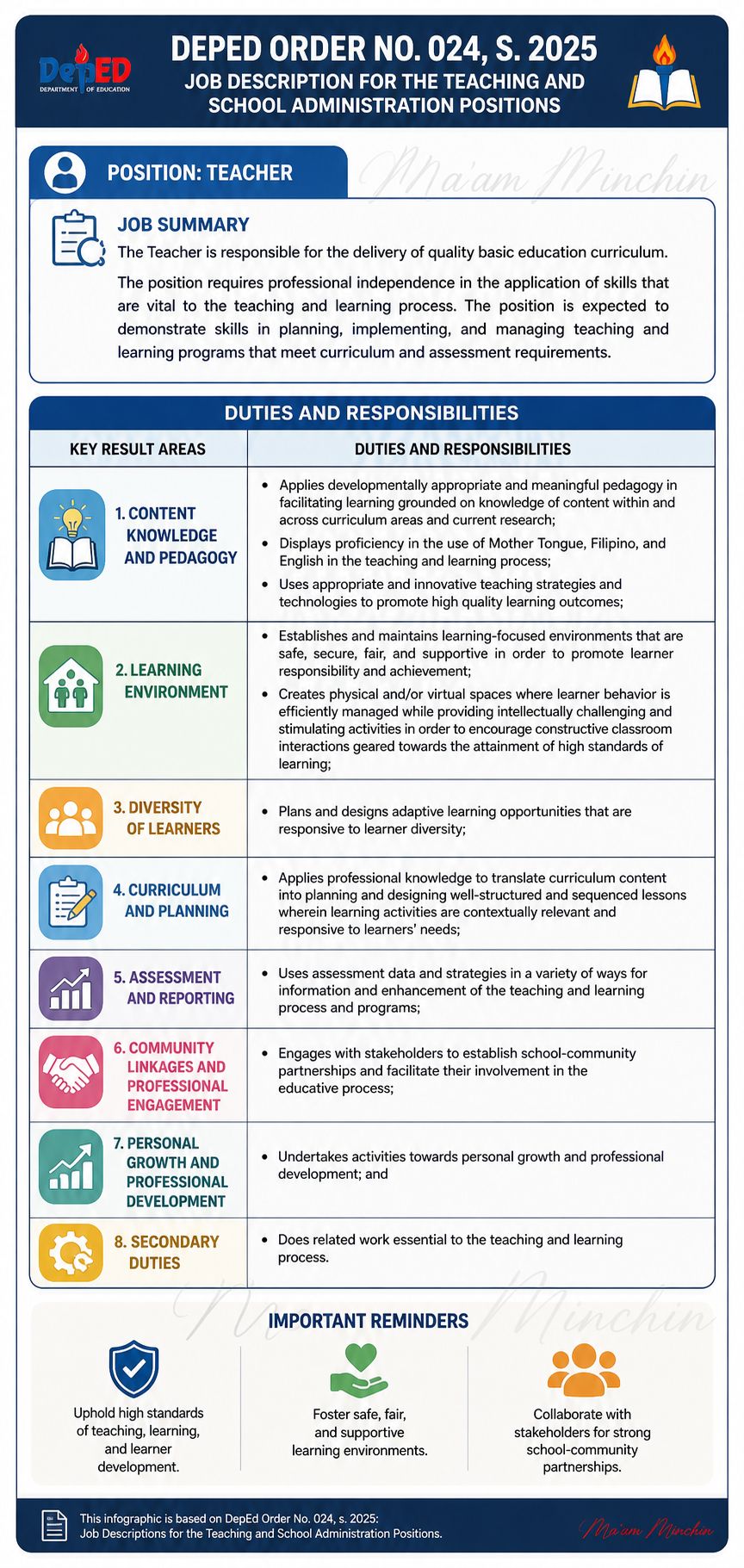
DepEd Order No. 024, s. 2025 highlights the vital role of teachers in delivering quality basic education. Teachers are expected to demonstrate strong content knowledge, inclusive pedagogy, effective assessment, and active community engagement while fostering safe, supportive, and learner-centered environments for continuous professional growth.
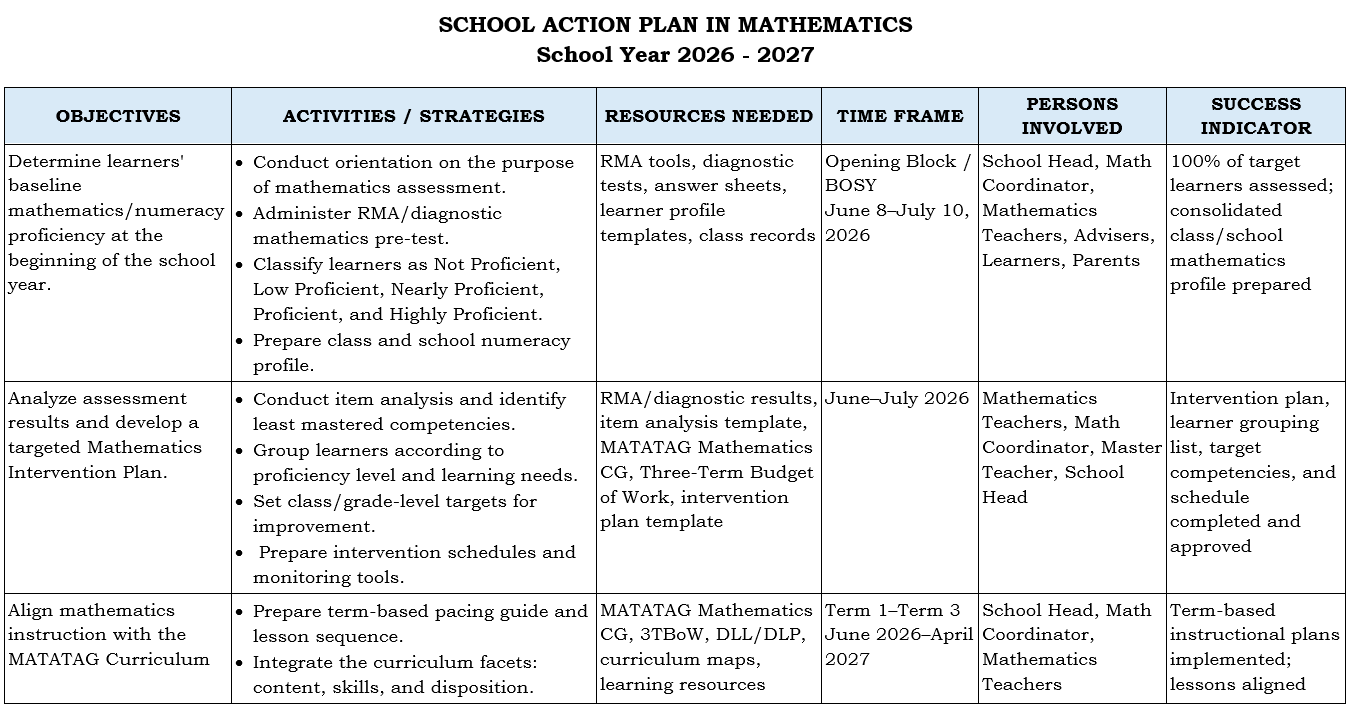
About This School Action Plan in Mathematics
This editable action plan provides a structured guide for implementing school-based mathematics activities. It includes objectives, strategies, resources, timelines, persons involved, and success indicators that may help schools address learner needs in Mathematics.
The plan highlights important areas such as baseline assessment, analysis of learner performance, differentiated instruction, remediation, enrichment, formative assessment, teacher capacity-building, parent involvement, and end-of-school-year evaluation.
DepEd Basis and AlignmentThis resource was prepared with consideration of relevant DepEd programs and references related to Mathematics instruction, curriculum implementation, learning recovery, and school planning.
- MATATAG Mathematics Curriculum – The Mathematics curriculum emphasizes the development of mathematical understanding, skills, reasoning, problem solving, and application of mathematical concepts.
- Three-Term School Calendar – The action plan is organized with term-based implementation, monitoring, review, and intervention adjustment in mind.
- ARAL Program and school-based intervention – The plan includes remediation and learner support activities for learners who need additional help in Mathematics and numeracy-related skills.
Teachers and school personnel may further customize this action plan depending on their school context, learner assessment results, available resources, and division or regional instructions.
What’s Included in the File?The editable Word file contains a complete action plan table with the following columns:
ObjectivesActivities / StrategiesResources NeededTime FramePersons InvolvedSuccess IndicatorMathematics goals and target outcomesSuggested instructional, assessment, intervention, and enrichment activitiesMaterials, forms, assessment tools, and learning resourcesSuggested implementation period based on the school yearTeachers, school heads, coordinators, learners, parents, and stakeholdersMeasurable indicators of progress and accomplishmentKey Features of the Action Plan- Editable Word format for easy customization
- Prepared for School Year 2026–2027
- Based on the Three-Term School Calendar structure
- Aligned with Mathematics instruction and learner support needs
- Includes assessment, intervention, enrichment, monitoring, and evaluation activities
- Useful for classroom, grade level, or school-level planning
- Teacher-friendly and ready to modify depending on school context
Teachers may use this Mathematics Action Plan as a guide in organizing activities for the school year. Since the file is editable, users can revise the school name, school year, timelines, target learners, activities, and success indicators based on actual school data and needs.
This resource may also be useful during school planning, Learning Action Cell sessions, mathematics program implementation, classroom intervention planning, and preparation of reports or monitoring documents.
Teacher Tip: Before using the action plan, review your learners’ baseline assessment results, least mastered competencies, available intervention time, and school calendar. This will help make the plan more responsive and realistic.Suggested Areas Covered in the Plan- Baseline Mathematics or numeracy assessment
- Analysis of assessment results and learner grouping
- Alignment of instruction with the MATATAG Curriculum
- Differentiated Mathematics instruction
- School-based remediation and ARAL-related support
- Enrichment activities for proficient learners
- Progress monitoring and formative assessment
- Term-based data review
- Teacher capacity-building through LAC and coaching
- Parent and stakeholder support
- Midyear assessment and intensified intervention
- End-of-school-year evaluation and reporting
This file is provided as a sample and editable reference for teachers. Schools may have different formats, timelines, and required contents depending on local guidelines, school improvement plans, division instructions, and actual learner needs. Always review, revise, and align the document with your school context before official use.
Why Action Plans Matter in MathematicsA well-prepared Mathematics Action Plan helps teachers and school leaders become more intentional in addressing learner needs. It supports data-driven decision-making by connecting assessment results with classroom instruction, remediation, enrichment, monitoring, and reporting.
Through a clear action plan, teachers can identify which learners need additional support, which competencies require more attention, and which strategies may help improve learner performance. It also encourages collaboration among teachers, school heads, parents, and other stakeholders.
Frequently Asked QuestionsIs this file editable?Yes. The file is prepared in editable Word format, so teachers may revise the school details, activities, timelines, persons involved, and success indicators.
Can this be used for all grade levels?The action plan may be used as a general school-level Mathematics planning reference. However, teachers are encouraged to adjust the activities and targets based on the specific grade level, curriculum competencies, and learner assessment results.
Is this already final for submission?This is a ready-to-edit template and sample action plan. Before submission, it should be reviewed and customized according to school format, actual needs, and instructions from school heads or division offices.
Is this based on the Three-Term School Calendar?Yes. The resource was prepared with the Three-Term School Calendar in mind, especially in organizing implementation periods, term-based reviews, monitoring, and end-of-term adjustments.
Final NotesEduFilesPH continues to create teacher-friendly resources that may help reduce preparation time and support better classroom and school planning. This School Action Plan in Mathematics is shared to assist teachers and school leaders as they prepare for School Year 2026–2027.
Feel free to customize the file according to your school’s needs. More action plans and teacher resources will be shared soon.
Use this link to download: School Action Plan in Mathematics (SY 2026-2027).docx
Or you may visit the Original Link: https://www.edufilesph.com/2026/05/school-action-plan-in-mathematics-for.html
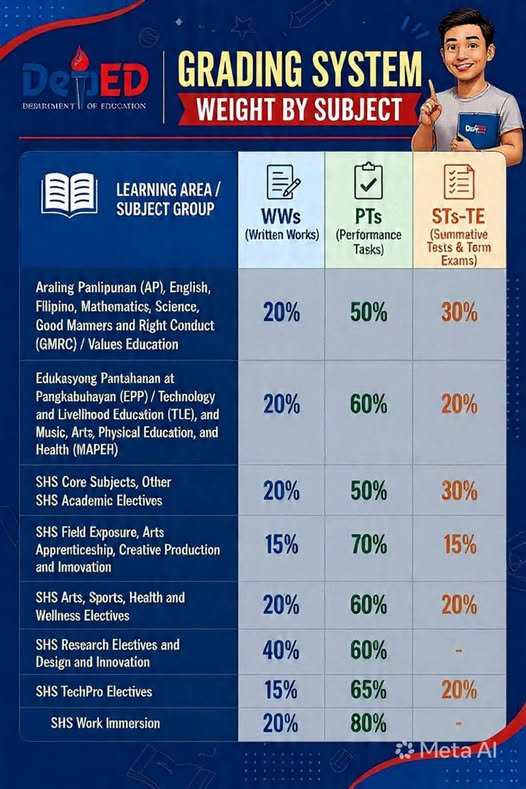
Grades are based on Written Works (WWs), Performance Tasks (PTs), and Summative Tests (STs)—with different weight distributions depending on the subject. This system ensures fair and balanced assessment of student learning across skills, knowledge, and performance. ✅📚
f you are verified using a link, or they ask you for OTP, password, account number, or personal details — it's a scam.
Do this immediately:
1. Do not click the link and do not reply.
2. Screenshot the message, sender, and link.
3. Forward a suspicious message to reportphishing@landbank.com .
4. If you clicked using your DepEd email, change the password immediately and report to ICT/admin.
5. If you have given LANDBANK details, OTP, or password, call immediately:
(02) 8-405-7000
1-800-10-405-7000
Take note:
LANDBANK does not ask for account verification via email or text with a link.
Possible phishing if:
• the sender is not official
• rushing you, like “verify now”
• asking for OTP, password, or account details
• the link is suspicious

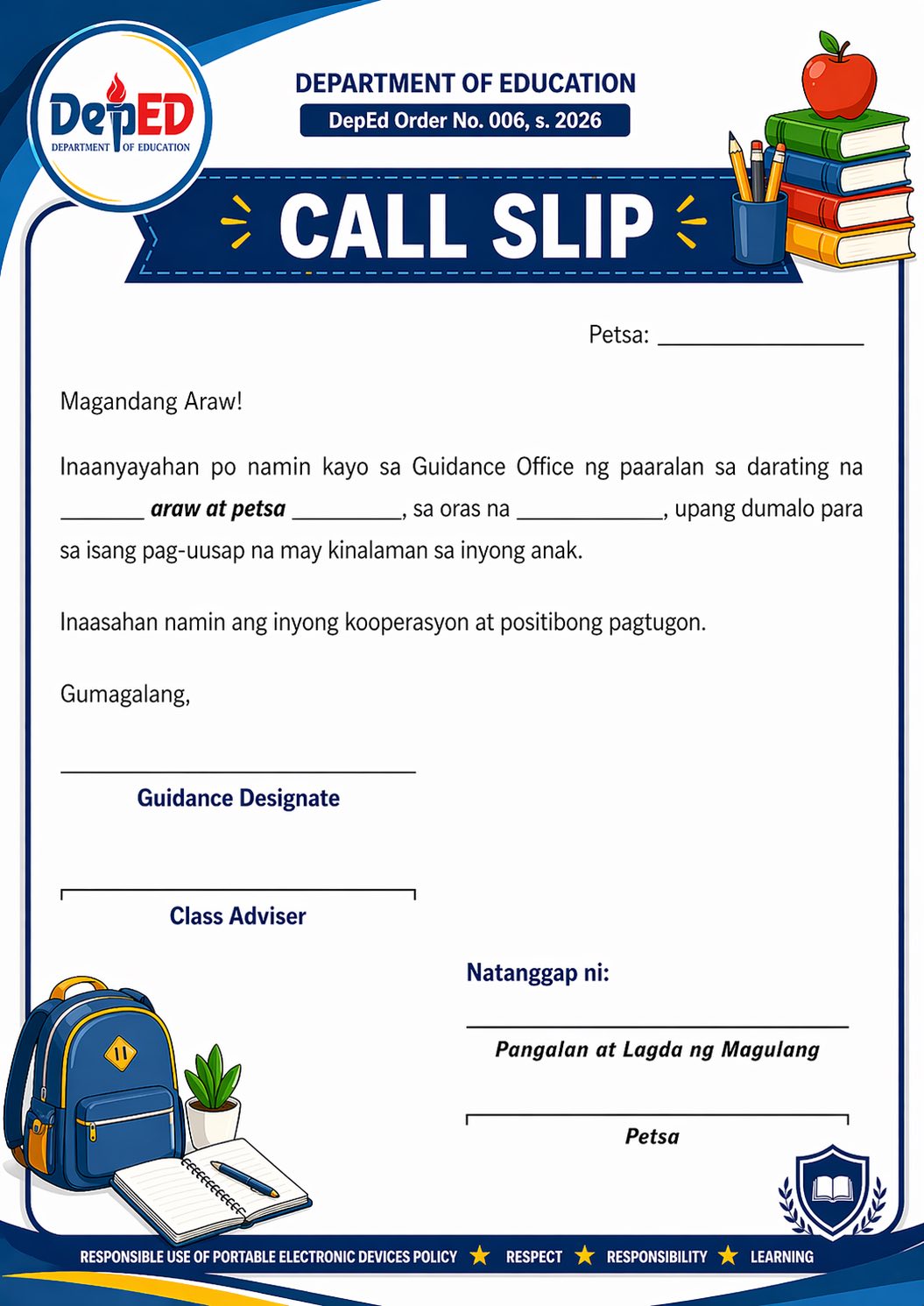
The Call Slip is an official communication from the school’s Guidance Office informing the parent or guardian of the need to visit the school on a specified date and time. Its purpose is to discuss a concern related to the learner and to collaboratively address matters that affect the student’s behavior, well-being, and academic development, with the expectation of the parent’s cooperation and positive response.
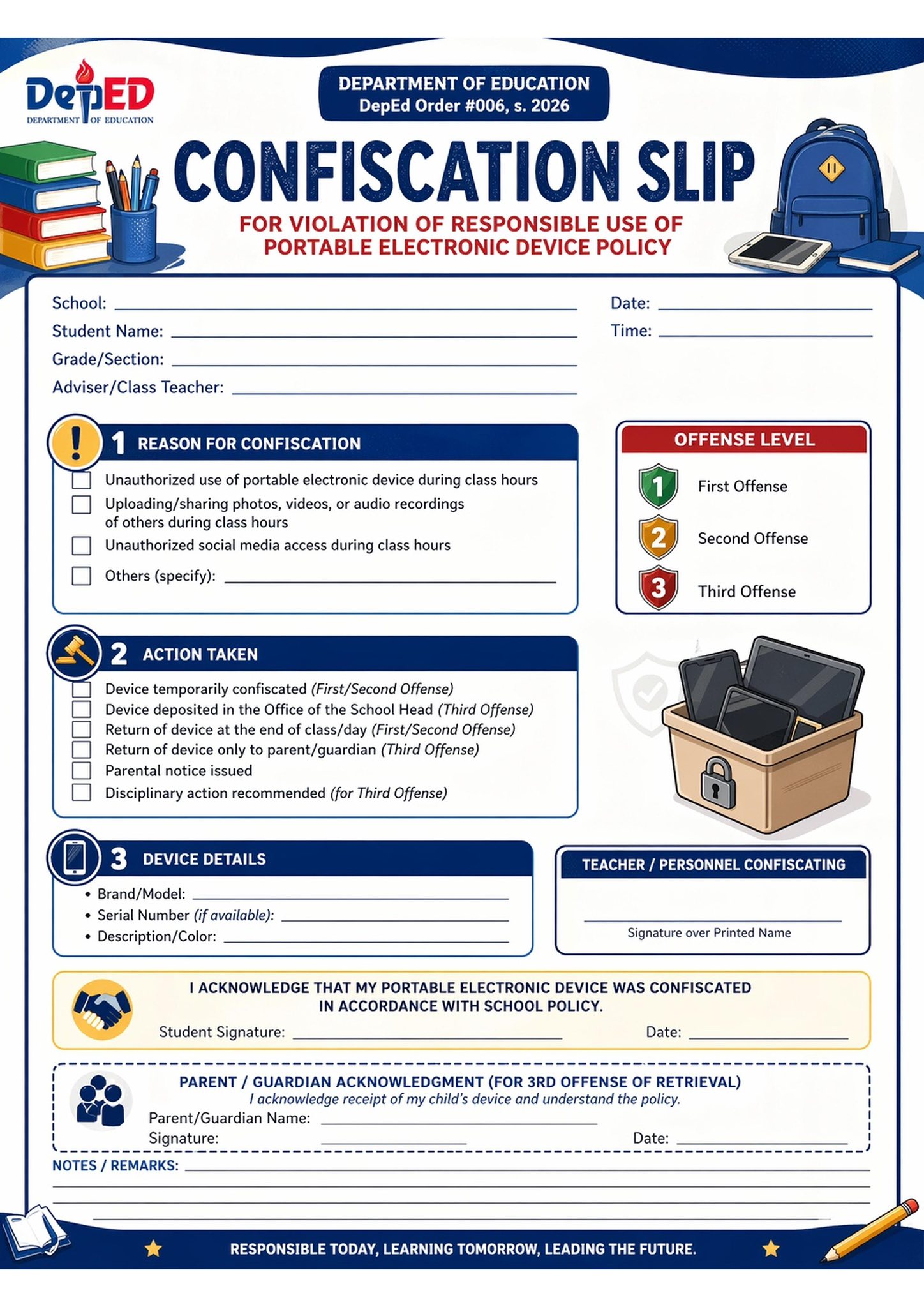
The Confiscation Slip serves as formal documentation for the confiscation of a learner’s portable electronic device due to a violation of the Responsible Use of Portable Electronic Devices Policy. It includes important details such as the reason for confiscation, the level of offense, the action taken, and the description of the device, and it requires acknowledgment from both the learner and the parent or guardian to ensure transparency and accountability.
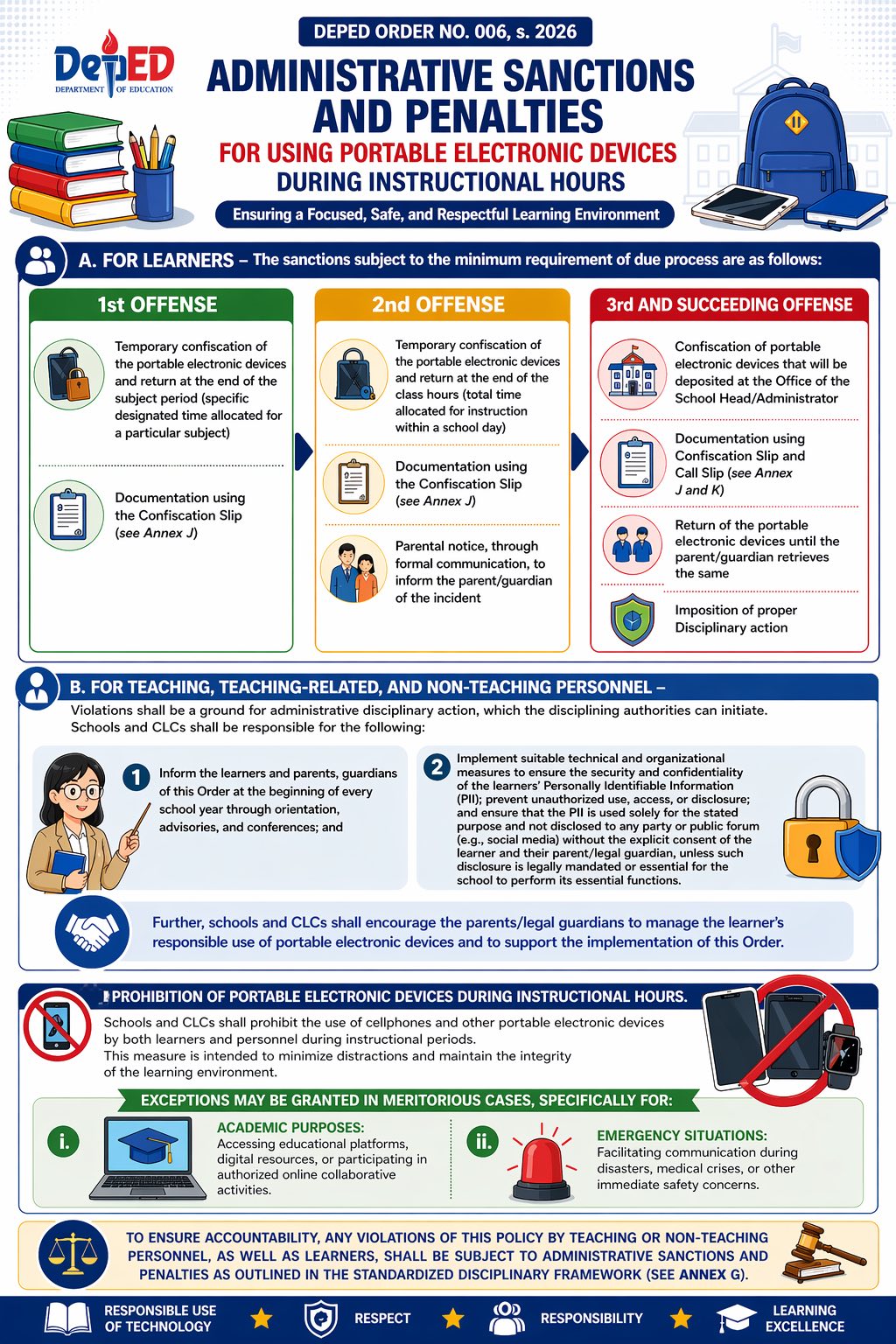
The Administrative Sanctions and Penalties outline the rules and corresponding disciplinary actions for the unauthorized use of portable electronic devices during instructional hours. The policy clearly defines the consequences for first, second, and third offenses, emphasizes due process, and assigns responsibilities to learners, parents, and school personnel. Its primary goal is to maintain a focused, safe, and respectful learning environment while allowing limited exceptions for academic purposes and emergency situations.
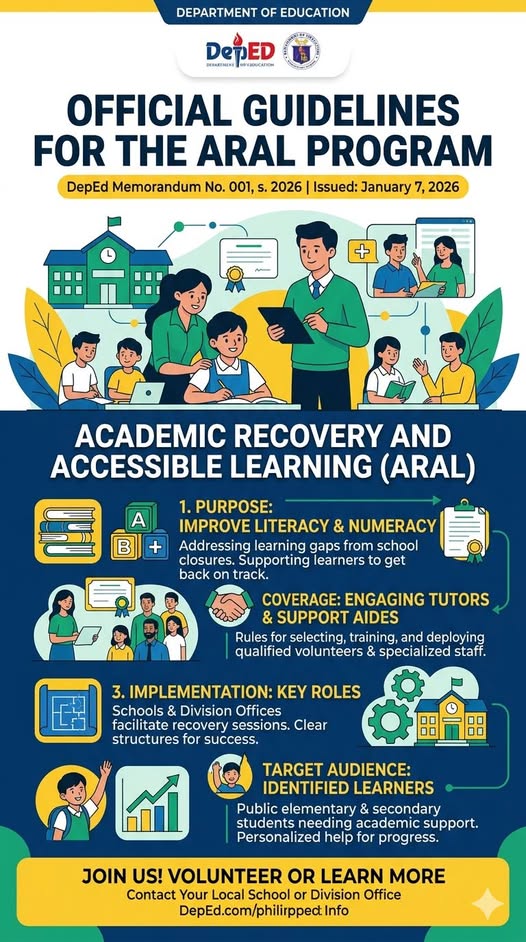
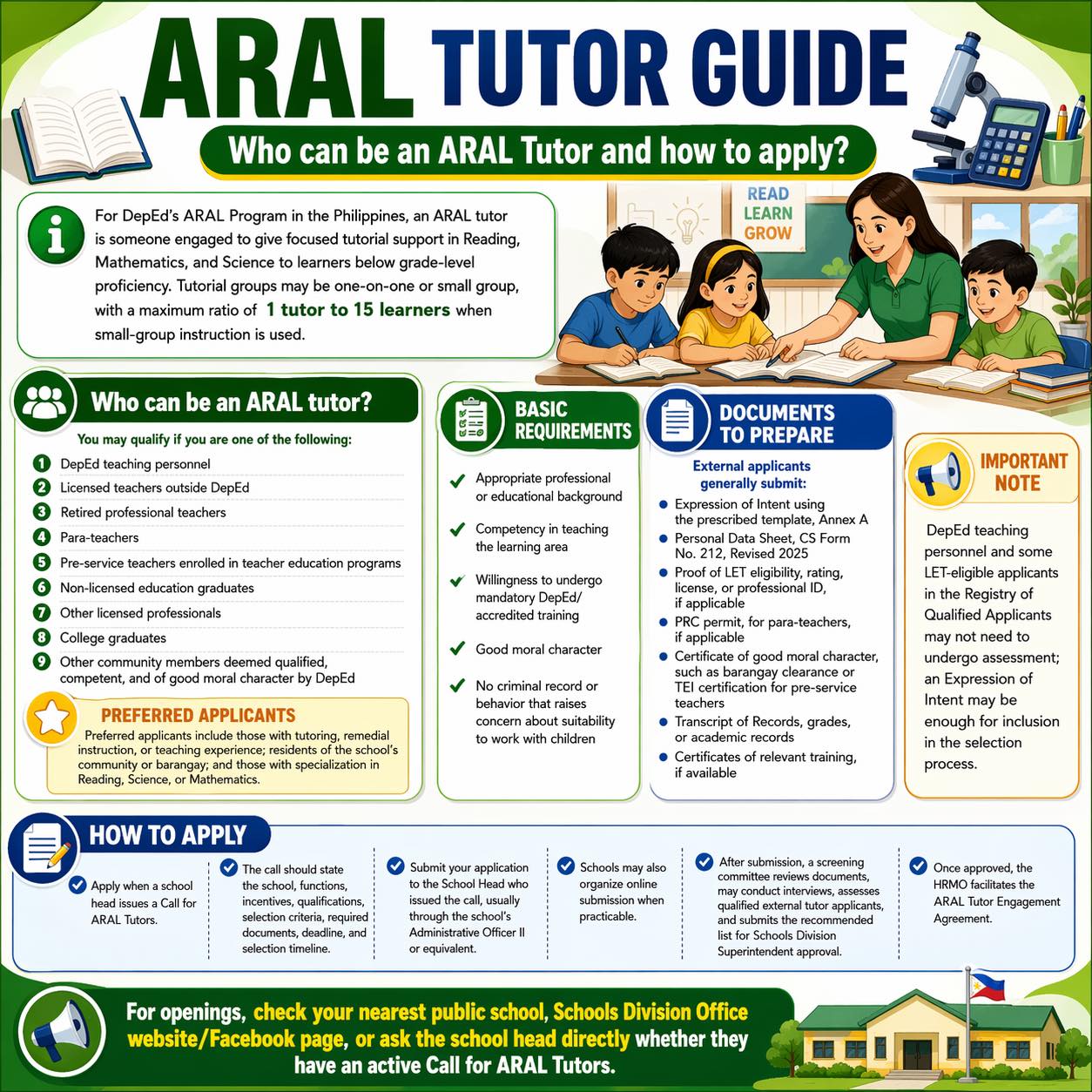
DepEd Memorandum No. 001, s. 2026, issued on January 7, 2026, provides the official guidelines for engaging tutors and support aides under the Academic Recovery and Accessible Learning #ARALProgram. It focuses on addressing learning gaps through structured tutoring by teachers and qualified volunteers.
🔑 Key Details of DM 001, s. 2026:
📌 Purpose: To implement the ARAL Program, aimed at improving literacy and numeracy skills among learners who fell behind during school closures.
📌 Coverage: It sets the rules for selecting, training, and deploying tutors, including specialized staff and community volunteers.
📌 Implementation: The memo outlines the roles of schools and division offices in facilitating these recovery sessions.
📌 Target Audience: Learners from public elementary and secondary schools who have been identified as needing academic support.
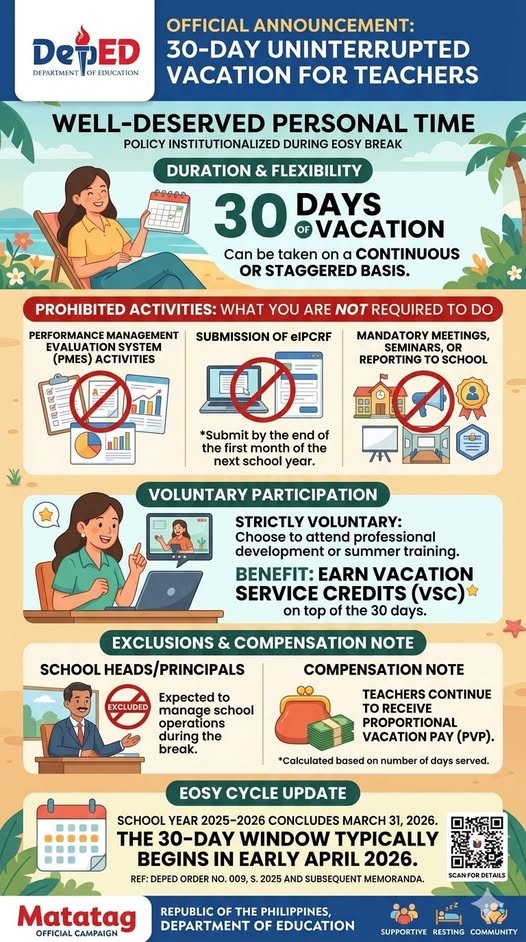
#UninterruptedVacation for public school teachers during the End-of-School-Year (EOSY) break.
The policy was formally introduced to address teacher burnout and ensure a "well-deserved personal time" without any school-related commitments.
📝 Core Guidelines of the 30-Day Break
According to DepEd Order No. 009, s. 2025 (and supported by subsequent memoranda), here are the specific details:
📅 Duration & Flexibility: Teachers are granted 30 days of vacation, which can be taken on a continuous or staggered basis.
⚠️ Prohibited Activities: During this 30-day window, teachers are not required to perform any school-related tasks, including:
❎️ Performance Management Evaluation System (PMES) activities.
❎️ Submission of the electronic Individual Performance Commitment and Review Form (eIPCRF), which can now be submitted by the end of the first month of the following school year.
❎️ Mandatory meetings, seminars, or reporting to school.
✅️ Voluntary Participation: If a teacher chooses to attend professional development or summer training during this period, it must be strictly voluntary.
Benefit: Participation in these activities earns the teacher Vacation Service Credits (VSC) on top of the 30-day limit.
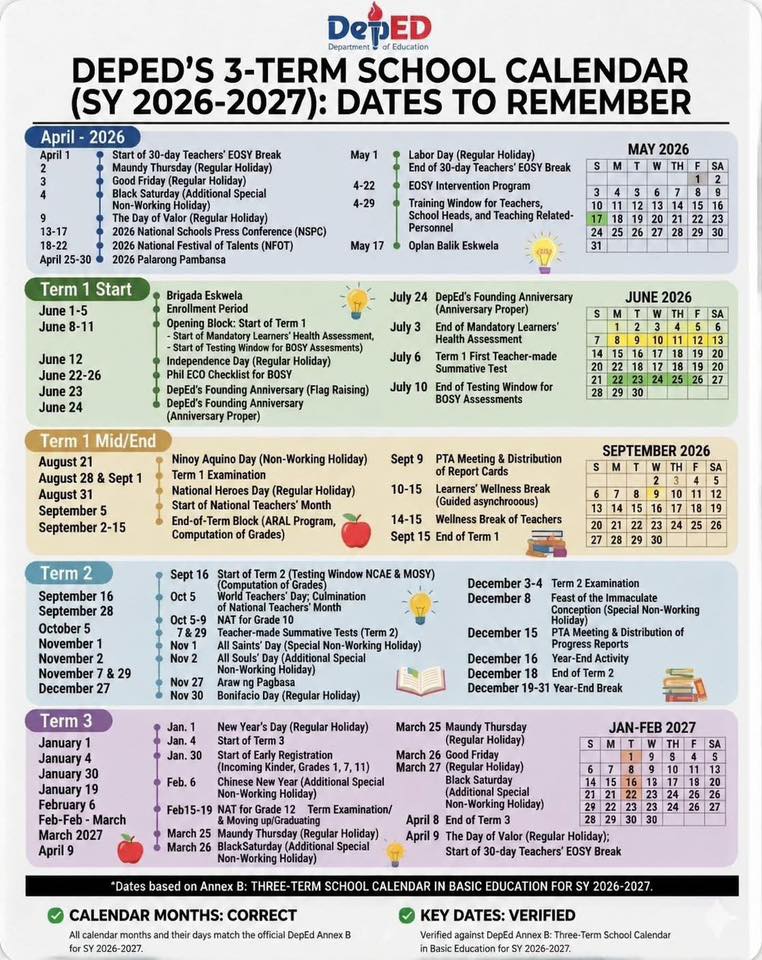
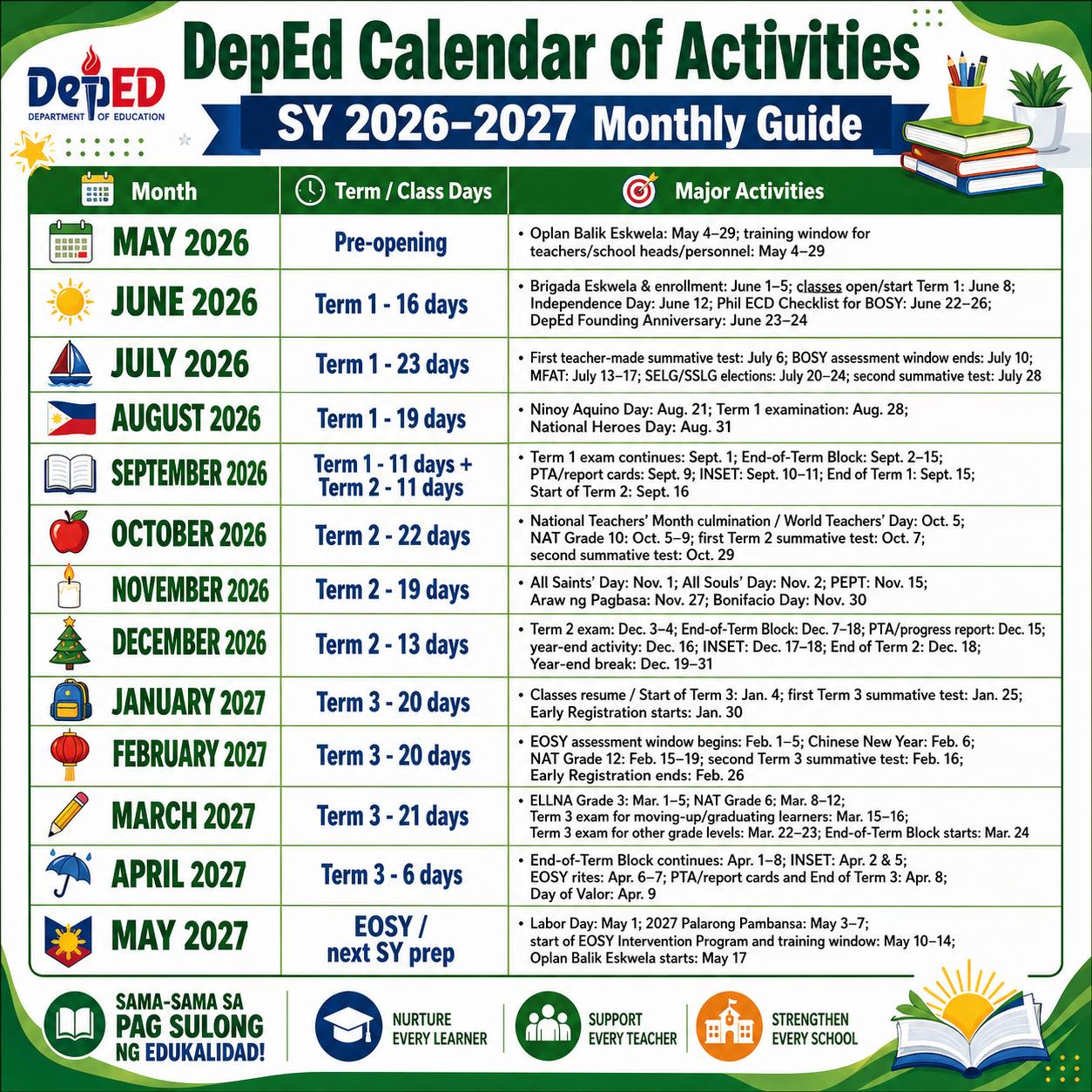
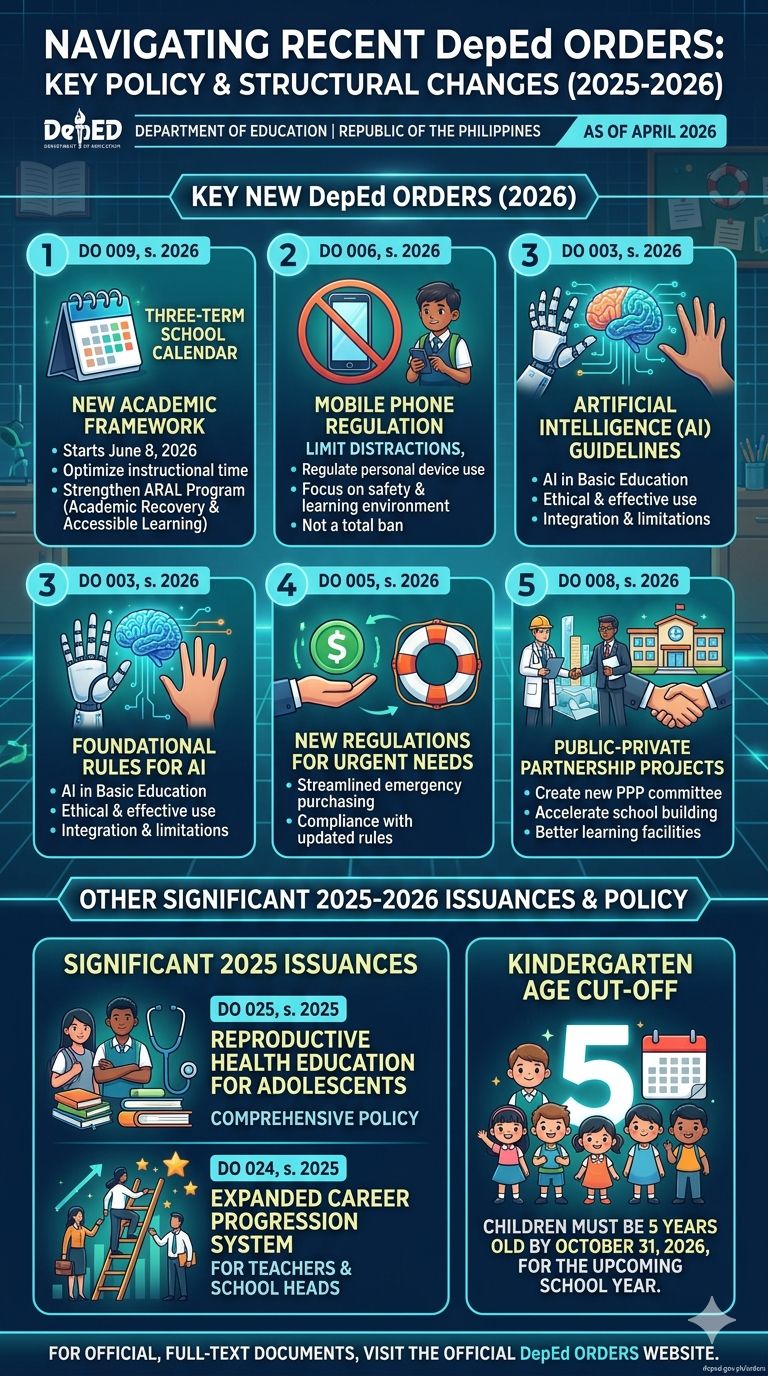
📌 DO 009, s. 2026 - Three-Term School Calendar: Establishes a new academic framework to optimize instructional time and strengthen the Academic Recovery and Accessible Learning (ARAL) Program.
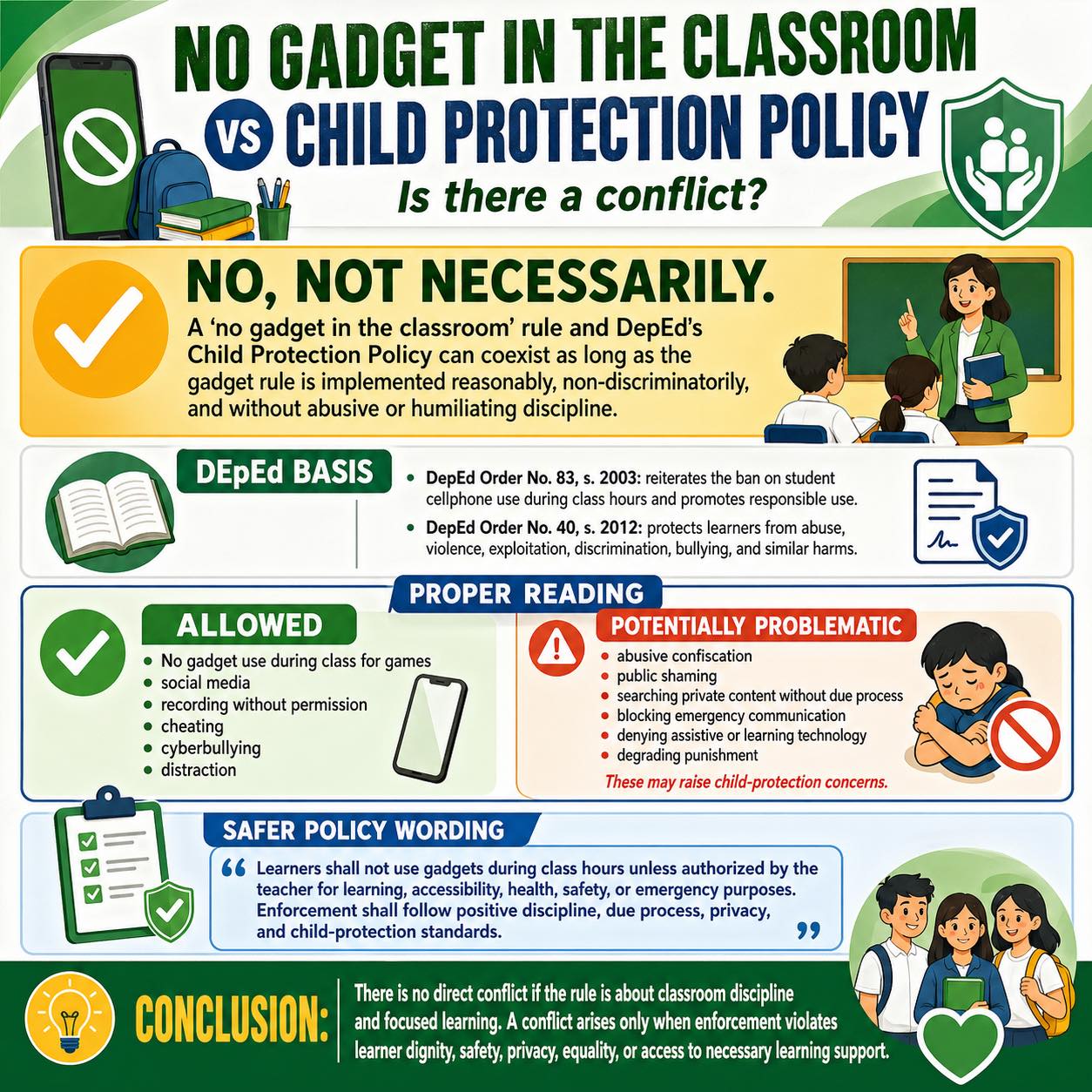
📌 DO 006, s. 2026 - Mobile Phone Regulation: Regulates the use of personal devices, focusing on limiting distractions and enforcing safety, rather than a total ban.
📌 DO 003, s. 2026 - Artificial Intelligence (AI) Guidelines: Establishes foundational rules for using AI in basic education.
📌 DO 005, s. 2026 - Emergency Procurement: Guidelines for emergency procurement following new regulations.
📌 DO 008, s. 2026 - PPP School Infrastructure: Creates a committee for Public-Private Partnership projects.
Other Significant 2025-2026 Issuances:
📌 DO 025, s. 2025: Policy on Reproductive Health Education for Adolescents.
📌 DO 024, s. 2025: Expanded Career Progression System for Teachers and School Heads.
📌 Kindergarten Age Cut-off: Children must be 5 years old by October 31, 2026, for the upcoming school year. See less
C
Starting School Year 2026-2027, the Department of Education (DepEd) will implement a Three-Term School Calendar (DO 009, s. 2026) to improve instructional time, reduce teacher workload, and address learning gaps. The school year will run from June 8, 2026, to April 8, 2027, featuring 201 class days divided into three terms, each with dedicated opening, instruction, and closing blocks.